 Research Breakthrough Possible @S-Logix

Office Address
- 2nd Floor, #7a, High School Road, Secretariat Colony Ambattur, Chennai-600053 (Landmark: SRM School) Tamil Nadu, India
- pro@slogix.in
- +91-81240 01111
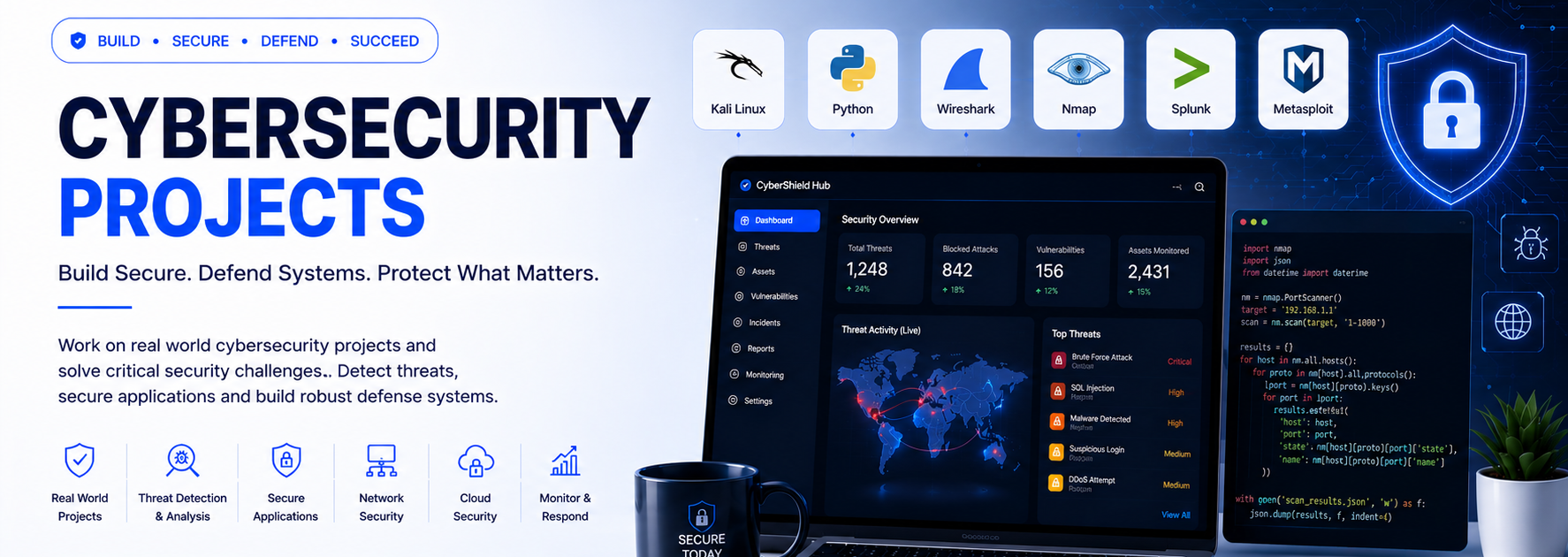
For students, interns, and cybersecurity engineers, the strongest practical projects are those that build a realistic lab, generate or replay security telemetry, detect suspicious behavior, investigate it, and automate response using tools actually used in SOC, cloud, network, and application-security environments.
Practical cybersecurity projects using real-time tools provide considerably more value than purely theoretical or simulation-only exercises because they expose learners to realistic security operations.
Students work with actual network traffic, system logs, security alerts, vulnerabilities, and incident scenarios rather than only textbook concepts.
Hands-on experience with tools and security platforms improves workplace readiness.
Projects develop practical Security Operations Center competencies.
Learners can study how security events progress from initial activity through detection, investigation, containment, and recovery within an authorized lab.
Students learn log collection, normalization, correlation rules, dashboards, alert generation, and security-event investigation.
Capturing and analyzing real network telemetry improves understanding of protocols, abnormal communication patterns, IDS/IPS operation, DNS behavior, and network anomalies.
Cloud-based projects introduce cloud logging, IAM monitoring, configuration assessment, workload protection, and cloud incident investigation.
Real security telemetry can support projects in anomaly detection, phishing classification, malware detection, intrusion detection, threat prioritization, and intelligent alert correlation.
Integrating SIEM with SOAR workflows teaches automated enrichment, ticket creation, notification, containment, and response orchestration.
Projects can correlate internal telemetry with indicators of compromise and structured threat intelligence, improving threat investigation skills.
Mapping detections to adversary tactics and techniques helps learners understand security incidents from an attacker-behavior perspective rather than simply identifying individual alerts.
Practical systems can be evaluated using various performance metrics to measure effectiveness.
A candidate who can demonstrate a functioning SOC, SIEM, EDR, cloud-security, DevSecOps, or automated incident-response project has concrete evidence of practical capability.
Practical cybersecurity projects help students transform cybersecurity concepts into hands-on technical capabilities through realistic tools, controlled environments, security telemetry, detection, investigation, and response activities.
| Skill Area | What Students Learn | Practical Activities |
|---|---|---|
| Networking fundamentals | TCP/IP, DNS, HTTP/S, ports, protocols and traffic behavior | Packet capture and traffic analysis using Wireshark/Zeek |
| Network security | IDS/IPS concepts, signatures, anomalies and attack indicators | Configure Suricata and analyze generated alerts |
| System security | Windows/Linux security, processes, services, permissions and logs | Monitor endpoints using Sysmon, Wazuh and osquery |
| SIEM & SOC operations | Log collection, correlation, dashboards and alert triage | Build a mini-SOC using Wazuh/Elastic |
| Threat detection | Recognizing suspicious activities and indicators | Develop detection rules and validate them against controlled test scenarios |
| Threat hunting | Proactively searching telemetry for suspicious behavior | Investigate endpoint and network logs |
| Incident investigation | Determining what happened, when, where and how | Correlate endpoint, network and authentication events |
| Incident response | Identification, containment, remediation and recovery | Develop and execute incident-response playbooks |
| Vulnerability management | Asset discovery, scanning, prioritization and remediation | Use Nmap and Greenbone/OpenVAS in an authorized lab |
| Web security | OWASP vulnerabilities and secure development principles | Test deliberately vulnerable applications with OWASP ZAP/Burp Suite |
| Cloud security | IAM, logging, configuration and cloud threat detection | Analyze AWS CloudTrail/GuardDuty security events |
| Container security | Image vulnerabilities and runtime threats | Use Trivy and Falco with Docker/Kubernetes |
| Threat intelligence | IOCs, TTPs and intelligence correlation | Work with MISP/OpenCTI and STIX/TAXII |
| MITRE ATT&CK | Adversary tactics and techniques | Map detected behavior to ATT&CK techniques |
Practical cybersecurity projects help learners convert technical knowledge into demonstrable skills that align with real-world cybersecurity roles across SOC operations, network security, cloud security, application security, threat intelligence, incident response, and security research.
Build relevant technical capabilities and demonstrate them through practical projects, tools, and real-world scenarios.
| Practical Skill Developed | Job Opportunities |
|---|---|
| SIEM, log analysis, alert investigation | SOC Analyst, Security Analyst |
| Wireshark, Zeek, Suricata, network monitoring | Network Security Engineer, NOC/SOC Analyst |
| Wazuh, Sysmon, endpoint monitoring | Endpoint Security Analyst, EDR Analyst |
| Vulnerability scanning and remediation | Vulnerability Analyst, Security Engineer |
| Web application security testing | Application Security Analyst, VAPT Engineer |
| Incident investigation and response | Incident Response Analyst, DFIR Analyst |
| Threat intelligence and MITRE ATT&CK | Threat Intelligence Analyst, Threat Hunter |
| AWS/Azure/GCP security | Cloud Security Engineer |
| Docker/Kubernetes security | Container/Cloud Security Engineer |
| SIEM + SOAR integration | SOC Automation/SOAR Engineer |
| Malware and forensic analysis | Malware Analyst, Digital Forensics Analyst |
| AI/ML-based attack detection | AI Security Engineer, Cybersecurity Researcher |
Hands-on Lab
Real-Time Tools
Controlled Cyber Scenarios
Major Project
Internship
Portfolio
Certification
Placement
A practical technology stack covering network defense, application security, threat intelligence, cloud protection, security analytics, and modern cyber research.
| 01 Security Category | 02 Tools | 03 Purpose |
|---|---|---|
|
01
Network
Security NETWORK DEFENSE |
Nmap | Discovers hosts, ports, and network services. |
| Wireshark | Captures and analyzes network traffic. | |
| Zeek | Monitors network activity and generates security telemetry. | |
| Suricata | Detects and blocks suspicious network traffic. | |
| Kismet | Detects and monitors wireless networks and devices. | |
|
02
Application
& API Security APPLICATION DEFENSE |
OWASP ZAP | Finds vulnerabilities in web applications and APIs. |
| Burp Suite | Intercepts and analyzes web/API traffic for security testing. | |
| Nuclei | Performs automated vulnerability detection using templates. | |
| Semgrep | Detects security vulnerabilities in source code. | |
| OWASP Dependency-Check | Identifies vulnerable software dependencies. | |
|
03
Vulnerability
Management RISK DISCOVERY |
Greenbone Community Edition | Scans systems for known vulnerabilities. |
| OpenSCAP | Assesses system security configurations and compliance. | |
| Trivy | Scans containers, code, and dependencies for vulnerabilities. | |
| DefectDojo | Manages, prioritizes, and tracks security findings. | |
|
04
Threat Detection
& Response DETECT & RESPOND |
Wazuh | Monitors endpoints and detects security threats. |
| Velociraptor | Supports endpoint monitoring, threat hunting, and investigation. | |
| OpenSearch | Analyzes and visualizes centralized security logs. | |
| Sigma | Provides portable rules for detecting suspicious log activity. | |
|
05
Threat Intelligence
& Malware Analysis THREAT RESEARCH |
MISP | Collects, manages, and shares threat intelligence. |
| OpenCTI | Correlates and visualizes cyber threat intelligence. | |
| YARA | Identifies malware using customizable detection rules. | |
| SpiderFoot | Automates OSINT and threat-intelligence reconnaissance. | |
|
06
Penetration Testing
& Security Validation SECURITY TESTING |
Kali Linux | Provides a security testing environment for penetration testing. |
| Metasploit Framework | Validates vulnerabilities through controlled exploitation. | |
| Nmap | Identifies exposed hosts, ports, and services. | |
| OWASP ZAP | Tests web applications and APIs for vulnerabilities. | |
|
07
Cloud &
Container Security CLOUD DEFENSE |
Prowler | Audits cloud environments for security misconfigurations. |
| ScoutSuite | Assesses cloud infrastructure security posture. | |
| Checkov | Detects security issues in Infrastructure-as-Code. | |
| kube-bench | Checks Kubernetes configurations against security benchmarks. | |
| Trivy | Scans containers and cloud-native workloads for vulnerabilities. | |
|
08
Identity &
Access Security ACCESS CONTROL |
Keycloak | Provides authentication, authorization, and single sign-on. |
| Open Policy Agent (OPA) | Enforces policy-based authorization and access control. | |
| FreeIPA | Provides centralized identity and authentication management. | |
| SPIFFE/SPIRE | Provides secure identities for distributed workloads. | |
|
09
Data Security
& Privacy DATA PROTECTION |
Microsoft Presidio | Detects and protects sensitive and personal information. |
| OpenDLP | Discovers sensitive data across systems and endpoints. | |
| Apache Ranger | Controls and manages access to sensitive data. | |
|
10
Security Architecture
& Compliance GOVERNANCE |
OWASP Threat Dragon | Supports threat modeling and security architecture analysis. |
| Lynis | Audits and hardens Linux and Unix systems. | |
| OpenSCAP | Validates system security configurations against standards. | |
| ComplianceAsCode | Automates security compliance and system-hardening policies. | |
|
11
AI-Powered Security
& Analytics INTELLIGENT DEFENSE |
Kitsune | Detects anomalous network activity using machine learning. |
| PyOD | Detects anomalies and outliers in security data. | |
| CICFlowMeter | Extracts network-flow features for security analytics and ML. | |
| Adversarial Robustness Toolbox (ART) | Tests ML models against adversarial attacks. | |
| Stratosphere IPS | Detects malicious network behavior using behavioral analysis. | |
|
12
Security Research
& Lab Platforms RESEARCH LAB |
Kali Linux | Provides a dedicated environment for security research and testing. |
| Ubuntu | Provides a flexible platform for security labs and research. | |
| VirtualBox | Creates isolated virtual environments for security research and testing. |
Explore practical Cybersecurity domains covering network security, web security, malware analysis, threat detection, digital forensics, cloud security, application security, identity management, security monitoring and intelligent cyber defense.
Build Cybersecurity projects that demonstrate complete security thinking — from monitoring networks and analyzing security events to detecting threats, investigating incidents and strengthening digital protection.
From project selection to successful implementation, S-Logix provides practical technical guidance, expert support, and industry-focused solutions to help students transform their ideas into real-world projects.
Our team is available to guide you through your project journey.
Contact the Slogix team for project selection, technical guidance, development support, implementation assistance, and project-related queries.
Share your project requirements, technology preferences, and project-related queries through our enquiry form. Our team will provide the appropriate technical guidance and support.
Reach the Slogix technical support team for project support and implementation assistance.