Research Breakthrough Possible @S-Logix

Office Address
- 2nd Floor, #7a, High School Road, Secretariat Colony Ambattur, Chennai-600053 (Landmark: SRM School) Tamil Nadu, India
- pro@slogix.in
- +91-81240 01111


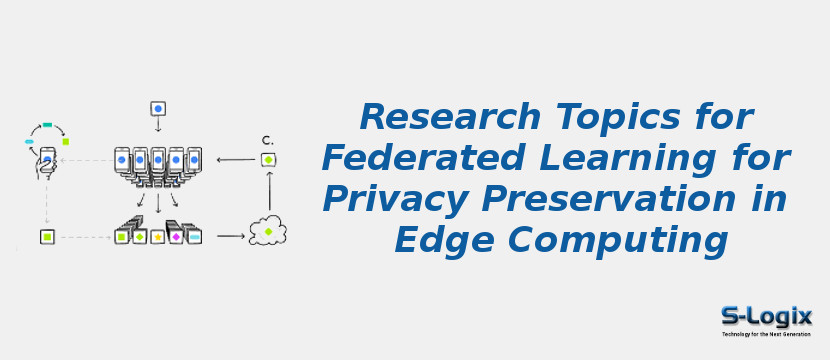
Research on Federated Learning for Privacy Preservation in Edge Computing focuses on enabling collaborative model training across distributed edge devices without sharing raw data, thereby maintaining data privacy while achieving intelligent, decentralized learning. This area addresses challenges such as heterogeneous device capabilities, non-IID (non-independent and identically distributed) data, limited bandwidth, and dynamic network conditions in edge environments. Key research directions include designing communication-efficient federated learning algorithms, secure aggregation techniques, and adaptive personalization for heterogeneous edge nodes. Other emerging topics involve integrating differential privacy, homomorphic encryption, or secure multi-party computation to enhance privacy guarantees, robust federated learning against adversarial attacks, and energy- and latency-aware model updates. Additionally, research on edge–cloud collaborative federated frameworks, privacy-preserving anomaly detection, and real-time decision-making for IoT and mobile applications represents significant avenues for advancing secure, efficient, and intelligent edge computing systems.