Research Breakthrough Possible @S-Logix

Office Address
- 2nd Floor, #7a, High School Road, Secretariat Colony Ambattur, Chennai-600053 (Landmark: SRM School) Tamil Nadu, India
- pro@slogix.in
- +91-81240 01111
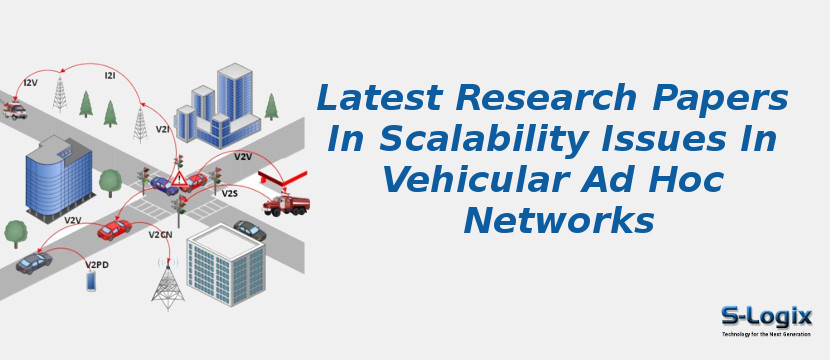
Recent research on scalability in VANETs highlights the major challenge of maintaining reliable and efficient communication when node densities increase and vehicular mobility becomes highly dynamic. Studies emphasise that as the number of vehicles and infrastructure nodes grows, traditional protocols suffer from broadcast storms, increased routing overhead, control-message flooding, and link failures due to topology changes. Several works propose hierarchical architectures—such as clustering, cloud/fog/edge-assisted models and SDN/NFV integration—to manage complexity and distribute control. Others focus on adaptive algorithms and optimization techniques (e.g., swarm intelligence, machine learning) to dynamically adjust parameters like transmission power, forwarding sets, and node grouping in response to network scale. The consensus is that future-proof VANET architectures must be inherently scalable, context-aware and capable of handling sudden increases in node participation, variable traffic density and heterogeneous connectivity without degrading performance.