How to Implement Greedy Scheduling Algorithm in ContainerCloudSim?
Share
Condition for Greedy Scheduling Algorithm in ContainerCloudSim
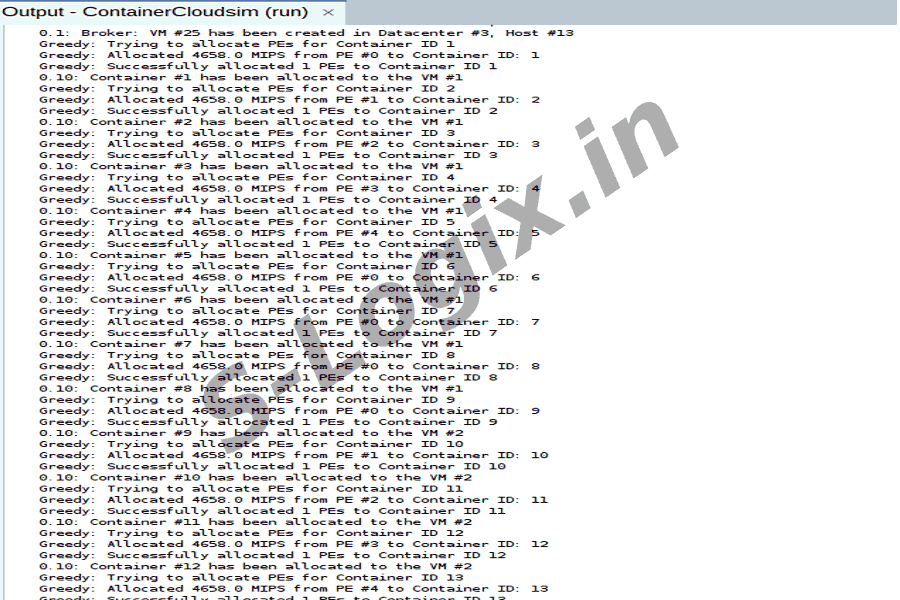
Description: The implemented Greedy Container Scheduler follows a best-fit allocation strategy where processing elements (PEs) are assigned to containers based on maximum available MIPS capacity. When a container requests CPU shares, the scheduler first sorts all available PEs in descending order of remaining MIPS, ensuring that the most powerful PEs are considered first. Similarly, the container’s requested MIPS shares are also sorted in descending order.
The scheduler then matches the highest-demand requests to the highest-capacity PEs, allocating resources one by one. If any requested MIPS share cannot be satisfied by the remaining PEs, the scheduler rolls back all partial allocations to avoid resource fragmentation, marking the allocation as failed.
Once allocated, the container retains its assigned PEs until deallocation. This greedy strategy ensures efficient utilization of high-performing resources and minimizes allocation overhead, but it may cause starvation or unfairness for smaller containers if large tasks repeatedly dominate the best resources.
/**
* A simple example showing how to create a data center with one host, one VM,
* one container and run one cloudlet on it.
*/
public class ContainerCloudSim {
/**
* The cloudlet list.
*/
private static List cloudletList;
/**
* The vmlist.
*/
private static List vmList;
/**
* The vmlist.
*/
private static List containerList;
/**
* The hostList.
*/
private static List hostList;
/**
* Creates main() to run this example.
*
* @param args the args
*/
public static void main(String[] args) {
Log.printLine("Starting ContainerCloudSimExample1...");
try {
/**
* number of cloud Users
*/
int num_user = 1;
/**
* The fields of calender have been initialized with the current
* date and time.
*/
Calendar calendar = Calendar.getInstance();
/**
* Deactivating the event tracing
*/
boolean trace_flag = false;
/**
* 1- Like CloudSim the first step is initializing the CloudSim
* Package before creating any entities.
*
*/
CloudSim.init(num_user, calendar, trace_flag);
/**
* 2- Defining the container allocation Policy. This policy
* determines how Containers are allocated to VMs in the data
* center.
*
*/
ContainerAllocationPolicy containerAllocationPolicy = new PowerContainerAllocationPolicySimple();
/**
* 3- Defining the VM selection Policy. This policy determines which
* VMs should be selected for migration when a host is identified as
* over-loaded.
*
*/
PowerContainerVmSelectionPolicy vmSelectionPolicy = new PowerContainerVmSelectionPolicyMaximumUsage();
/**
* 4- Defining the host selection Policy. This policy determines
* which hosts should be selected as migration destination.
*
*/
HostSelectionPolicy hostSelectionPolicy = new HostSelectionPolicyFirstFit();
/**
* 5- Defining the thresholds for selecting the under-utilized and
* over-utilized hosts.
*/
double overUtilizationThreshold = 0.80;
double underUtilizationThreshold = 0.70;
/**
* 6- The host list is created considering the number of hosts, and
* host types which are specified in the {@link ConstantsExamples}.
*/
hostList = new ArrayList();
hostList = createHostList(ConstantsExamples.NUMBER_HOSTS);
cloudletList = new ArrayList();
vmList = new ArrayList();
/**
* 7- The container allocation policy which defines the allocation
* of VMs to containers.
*/
ContainerVmAllocationPolicy vmAllocationPolicy = new PowerContainerVmAllocationPolicyMigrationAbstractHostSelection(hostList, vmSelectionPolicy,
hostSelectionPolicy, overUtilizationThreshold, underUtilizationThreshold);
/**
* 8- The overbooking factor for allocating containers to VMs. This
* factor is used by the broker for the allocation process.
*/
int overBookingFactor = 80;
ContainerDatacenterBroker broker = createBroker(overBookingFactor);
int brokerId = broker.getId();
/**
* 9- Creating the cloudlet, container and VM lists for submitting
* to the broker.
*/
cloudletList = createContainerCloudletList(brokerId, ConstantsExamples.NUMBER_CLOUDLETS);
containerList = createContainerList(brokerId, ConstantsExamples.NUMBER_CLOUDLETS);
vmList = createVmList(brokerId, ConstantsExamples.NUMBER_VMS);
/**
* 10- The address for logging the statistics of the VMs, containers
* in the data center.
*/
String logAddress = "~/Results";
/**
* 11- Submitting the cloudlet's , container's , and VM's lists to
* the broker.
*/
broker.submitCloudletList(cloudletList.subList(0, containerList.size()));
broker.submitContainerList(containerList);
broker.submitVmList(vmList);
/**
* 12- Determining the simulation termination time according to the
* cloudlet's workload.
*/
CloudSim.terminateSimulation(86400.00);
/**
* 13- Starting the simualtion.
*/
CloudSim.startSimulation();
/**
* 14- Stopping the simualtion.
*/
CloudSim.stopSimulation();
/**
* 15- Printing the results when the simulation is finished.
*/
List newList = broker.getCloudletReceivedList();
printCloudletList(newList);
/**
* It creates a specific name for the experiment which is used for creating
* the Log address folder.
*/
private static String getExperimentName(String... args) {
StringBuilder experimentName = new StringBuilder();
for (int i = 0; i < args.length; ++i) {
if (!args[i].isEmpty()) {
if (i != 0) {
experimentName.append("_");
}
/**
* Prints the Cloudlet objects.
*
* @param list list of Cloudlets
*/
private static void printCloudletList(List list) {
int size = list.size();
ContainerCloudlet cloudlet;
/**
* Create the Virtual machines and add them to the list
*
* @param brokerId
* @param containerVmsNumber
*/
private static ArrayList createVmList(int brokerId, int containerVmsNumber) {
ArrayList containerVms = new ArrayList();
for (int i = 0; i < containerVmsNumber; ++i) {
ArrayList peList = new ArrayList();
int vmType = i / (int) Math.ceil((double) containerVmsNumber / 4.0D);
for (int j = 0; j < 5; ++j) {// 5 = No of PEs
peList.add(new ContainerPe(j, new ContainerPeProvisionerSimple((double) ConstantsExamples.VM_MIPS[vmType])));
}
// Change this line to use FCFS scheduler instead of time-shared
containerVms.add(new PowerContainerVm(IDs.pollId(ContainerVm.class), brokerId,
(double) ConstantsExamples.VM_MIPS[vmType], (float) ConstantsExamples.VM_RAM[vmType],
ConstantsExamples.VM_BW, ConstantsExamples.VM_SIZE, "Xen",
new ContainerSchedulerFCFS(peList), // Using FCFS scheduler here
new ContainerRamProvisionerSimple(ConstantsExamples.VM_RAM[vmType]),
new ContainerBwProvisionerSimple(ConstantsExamples.VM_BW),
peList, ConstantsExamples.SCHEDULING_INTERVAL));
}
return containerVms;
}
/**
* Create the host list considering the specs listed in the
* {@link ConstantsExamples}.
*
* @param hostsNumber
* @return
*/
public static List createHostList(int hostsNumber) {
ArrayList hostList = new ArrayList();
for (int i = 0; i < hostsNumber; ++i) {
int hostType = i / (int) Math.ceil((double) hostsNumber / 3.0D);
ArrayList peList = new ArrayList();
for (int j = 0; j < ConstantsExamples.HOST_PES[hostType]; ++j) {
peList.add(new ContainerVmPe(j,
new ContainerVmPeProvisionerSimple((double) ConstantsExamples.HOST_MIPS[hostType])));
}
hostList.add(new PowerContainerHostUtilizationHistory(IDs.pollId(ContainerHost.class),
new ContainerVmRamProvisionerSimple(ConstantsExamples.HOST_RAM[hostType]),
new ContainerVmBwProvisionerSimple(1000000L), 1000000L, peList,
new ContainerVmSchedulerTimeSharedOverSubscription(peList),
ConstantsExamples.HOST_POWER[hostType]));
}
/**
* create the containers for hosting the cloudlets and binding them
* together.
*
* @param brokerId
* @param containersNumber
* @return
*/
public static List createContainerList(int brokerId, int containersNumber) {
ArrayList containers = new ArrayList();
for (int i = 0; i < containersNumber; ++i) {
int containerType = i / (int) Math.ceil((double) containersNumber / 3.0D);
public class ContainerSchedulerFCFS extends ContainerScheduler {
public ContainerSchedulerFCFS(List pelist) {
super(pelist);
}
@Override
public boolean allocatePesForContainer(Container container, List mipsShare) {
Log.printConcatLine("FCFS: Trying to allocate PEs for Container ID ", container.getId());
if (getPeCapacity() < mipsShare.size()) {
Log.printLine("FCFS: Not enough PE capacity. Needed: " + mipsShare.size() + ", Available: " + getPeCapacity());
return false;
}
if (container.getContainerPeAllocation() == null) {
List allocatedPes = new ArrayList<>();
for (int i = 0; i < mipsShare.size(); i++) {
ContainerPe pe = getPeList().get(i);
allocatedPes.add(pe);
Log.printLine("FCFS: Allocated PE #" + i + " with MIPS: " + pe.getMips() + " to Container ID: " + container.getId());
}
 Research Breakthrough Possible @S-Logix