Research Breakthrough Possible @S-Logix

Office Address
- 2nd Floor, #7a, High School Road, Secretariat Colony Ambattur, Chennai-600053 (Landmark: SRM School) Tamil Nadu, India
- pro@slogix.in
- +91-81240 01111
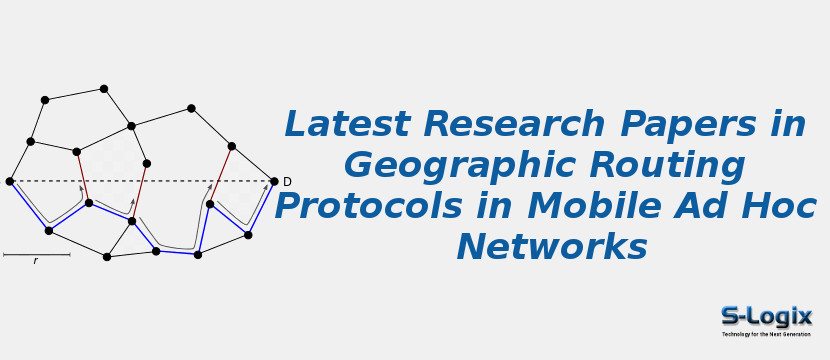
Latest research in Geographic Routing Protocols in Mobile Ad Hoc Networks (MANETs) focuses on leveraging location information to achieve energy-efficient, scalable, and low-latency communication in dynamic network topologies. Modern studies enhance traditional schemes like LAR, GPSR, and DREAM by incorporating node scoring mechanisms, mobility prediction, and intersection-based decision models to improve packet delivery and reduce path breakage. Energy- and load-balanced geographic routing frameworks are being developed to distribute forwarding responsibilities evenly among nodes, extending network lifetime in dense and mobile scenarios. Recent hybrid geographic protocols integrate machine learning and clustering techniques to optimize next-hop selection and adapt to frequent topology changes. Comparative simulations reveal that geographic routing achieves superior scalability and reduced routing overhead compared to topology-based methods, especially in location-aware and vehicular MANET environments. Overall, emerging geographic routing research emphasizes context-aware, mobility-adaptive, and energy-optimized designs that ensure reliable and efficient data dissemination in next-generation MANETs.