Research Breakthrough Possible @S-Logix

Office Address
- 2nd Floor, #7a, High School Road, Secretariat Colony Ambattur, Chennai-600053 (Landmark: SRM School) Tamil Nadu, India
- pro@slogix.in
- +91-81240 01111
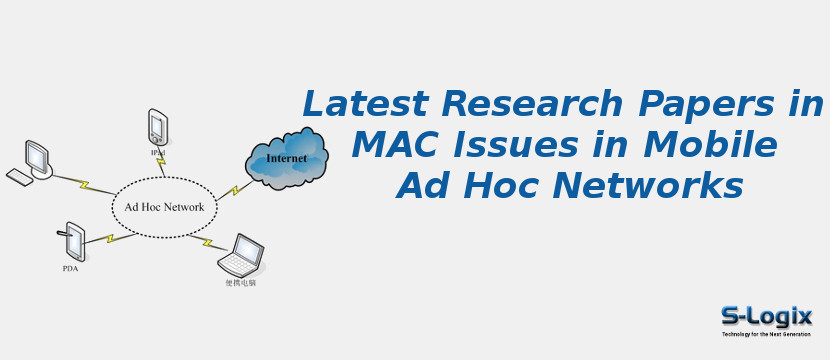
Recent research on MAC issues in Mobile Ad Hoc Networks (MANETs) focuses on addressing challenges such as collision avoidance, hidden and exposed terminal problems, dynamic topology handling, and energy-efficient communication. Since MANETs operate without fixed infrastructure and rely on shared wireless channels, MAC protocols must adapt to frequent topology changes, interference, and varying traffic loads. Recent studies propose adaptive, hybrid, and learning-based MAC schemes that optimize channel access using reinforcement learning, cross-layer design, and intelligent contention management. Directional antennas and TDMA-based scheduling approaches have been explored to reduce contention and improve throughput, while energy-aware MAC protocols aim to balance performance with battery constraints. Overall, these advancements in MAC layer design significantly enhance network reliability, scalability, and energy efficiency in mobile and dynamic environments.