Research Breakthrough Possible @S-Logix

Office Address
- 2nd Floor, #7a, High School Road, Secretariat Colony Ambattur, Chennai-600053 (Landmark: SRM School) Tamil Nadu, India
- pro@slogix.in
- +91-81240 01111
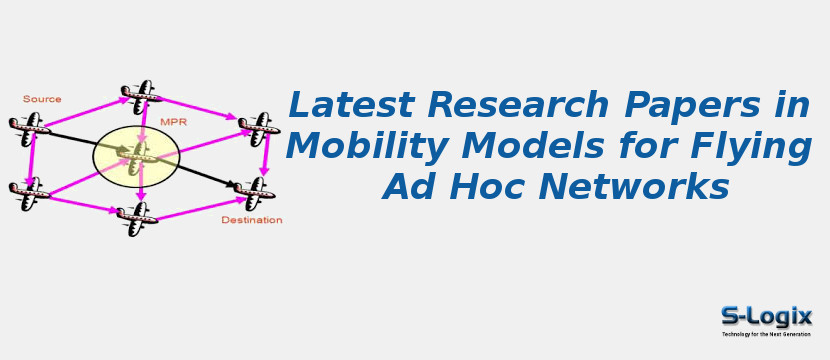
Research in mobility models for Flying Ad Hoc Networks (FANETs) focuses on accurately representing the dynamic and three-dimensional movement patterns of unmanned aerial vehicles (UAVs) to improve network design, simulation, and performance evaluation. Recent studies introduce realistic, environment-aware, and mission-specific mobility models that capture factors such as wind effects, flight dynamics, and obstacle avoidance. Machine learning and reinforcement learning techniques are increasingly applied to predict UAV trajectories and optimize path planning for coordinated flight operations. Hybrid and group-based mobility models are also explored to simulate swarm and formation flying behaviors, enhancing connectivity and reducing link breakages. These advanced mobility models play a crucial role in evaluating routing protocols, energy consumption, and communication reliability in rapidly changing FANET environments.