Research Breakthrough Possible @S-Logix

Office Address
- 2nd Floor, #7a, High School Road, Secretariat Colony Ambattur, Chennai-600053 (Landmark: SRM School) Tamil Nadu, India
- pro@slogix.in
- +91-81240 01111
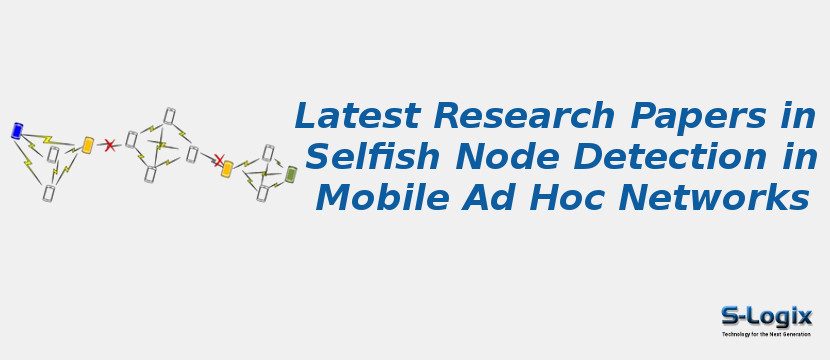
Recent research in selfish node detection in Mobile Ad Hoc Networks (MANETs) focuses on designing intelligent, trust-based, and socially aware mechanisms to identify nodes that refuse to forward packets to conserve their own resources, thereby degrading overall network performance. Modern techniques employ probabilistic trust models, machine learning classifiers, and enhanced routing protocols such as AODV and DSR to monitor node cooperation and isolate selfish behavior. Approaches like Bates distribution-inspired trust factors and social trust confirmation algorithms leverage statistical and relationship-based trust computation to improve detection accuracy and reduce false positives. Hybrid frameworks combining behavioral observation, reputation systems, and adaptive thresholds ensure dynamic response to varying mobility and topology conditions. Recent advancements also emphasize energy-efficient, lightweight, and distributed architectures capable of real-time selfish node identification, maintaining balanced network load and improving packet delivery ratio in resource-constrained MANET environments.