Research Breakthrough Possible @S-Logix

Office Address
- 2nd Floor, #7a, High School Road, Secretariat Colony Ambattur, Chennai-600053 (Landmark: SRM School) Tamil Nadu, India
- pro@slogix.in
- +91-81240 01111
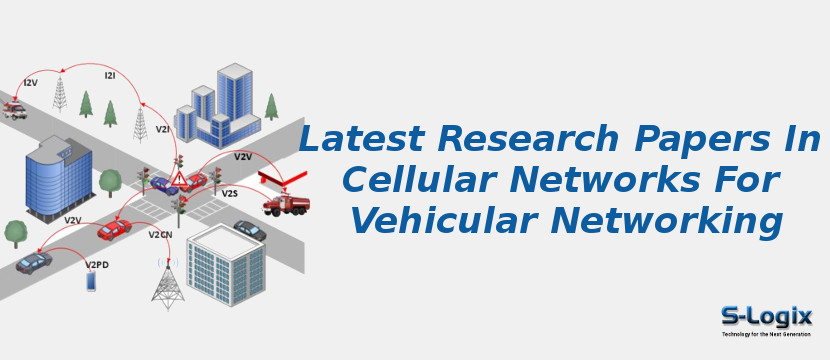
Recent research into cellular networks for vehicular networking—often framed as Cellular V2X or C-V2X—focuses on leveraging 4G, 5G and beyond to support ultra-reliable, low-latency vehicle communications in dynamic, high-mobility environments. Studies examine evolving standards from 3GPP (e.g., Release 14 LTE-V2X through NR-V2X) and explore issues such as sidelink resource scheduling, spectrum management, network slicing, and the operational challenges of large-scale deployment under dense traffic conditions. For example, novel scheduling schemes prioritize V2X traffic based on delay-sensitivity and channel quality to ensure safety-critical messaging meets stringent QoS demands. Research also investigates how cellular networks can co-exist or interwork with other vehicular communication technologies (like DSRC) to handle heterogeneous scenarios. These advancements contribute to building a robust communication backbone for connected and autonomous vehicles, intelligent transportation systems, and the smart-city mobility fabric.