Research Breakthrough Possible @S-Logix

Office Address
- 2nd Floor, #7a, High School Road, Secretariat Colony Ambattur, Chennai-600053 (Landmark: SRM School) Tamil Nadu, India
- pro@slogix.in
- +91-81240 01111
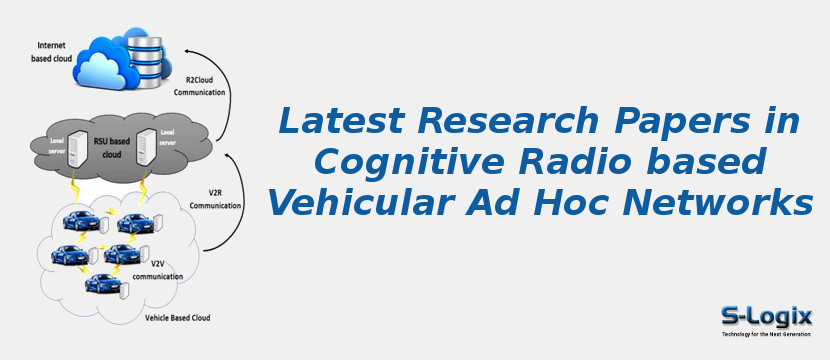
Research in Cognitive Radio based Vehicular Ad Hoc Networks (CR-VANETs) focuses on enhancing spectrum utilization, communication reliability, and adaptability in highly dynamic vehicular environments. Recent studies propose intelligent spectrum sensing and dynamic access schemes that allow vehicles to efficiently detect and utilize unused frequency bands without interfering with licensed users. Machine learning and deep reinforcement learning techniques are increasingly applied for spectrum prediction, channel selection, and decision-making to improve throughput and reduce latency. Security-aware and trust-based cognitive frameworks are also developed to prevent spectrum misuse and malicious attacks such as jamming or falsified sensing reports. Additionally, blockchain and edge computing are integrated with cognitive radio architectures to ensure decentralized control, secure data sharing, and low-latency communication. These advancements significantly improve spectrum efficiency, network scalability, and overall performance of next-generation CR-VANET systems.