Research Breakthrough Possible @S-Logix

Office Address
- 2nd Floor, #7a, High School Road, Secretariat Colony Ambattur, Chennai-600053 (Landmark: SRM School) Tamil Nadu, India
- pro@slogix.in
- +91-81240 01111
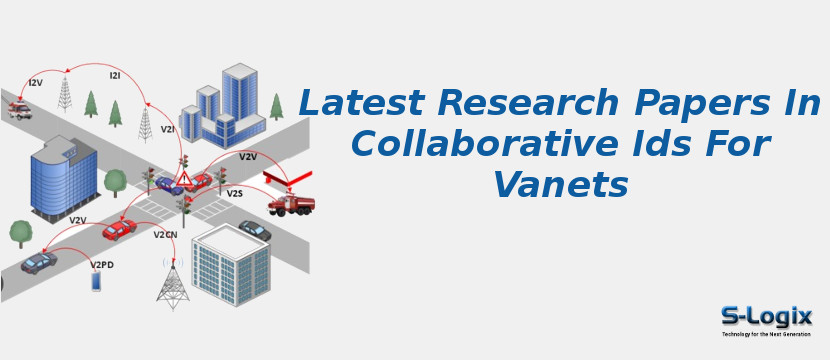
Recent research in collaborative intrusion detection systems (IDS) for vehicular ad-hoc networks (VANETs) is increasingly focusing on distributed learning frameworks where vehicles and roadside infrastructure cooperate to detect, share, and respond to threats in real time. These approaches leverage ensemble machine-learning models, federated learning, and deep reinforcement-learning techniques to build a system in which each vehicle contributes local observations (such as anomalous message patterns or neighbor misbehaviour) while selectively sharing relevant intelligence rather than raw data, thus preserving privacy and reducing overhead. Trust metrics and incentive mechanisms are incorporated to filter out unreliable collaborators and mitigate malicious insiders, while communication-efficient protocols ensure timely alert propagation despite high mobility and intermittent connectivity. By combining local detection with global collaboration, these IDS frameworks aim to achieve higher detection accuracy, lower false alarms, and faster response times in VANET environments subject to dynamic threats and evolving attack behaviours.