Research Breakthrough Possible @S-Logix

Office Address
- 2nd Floor, #7a, High School Road, Secretariat Colony Ambattur, Chennai-600053 (Landmark: SRM School) Tamil Nadu, India
- pro@slogix.in
- +91-81240 01111
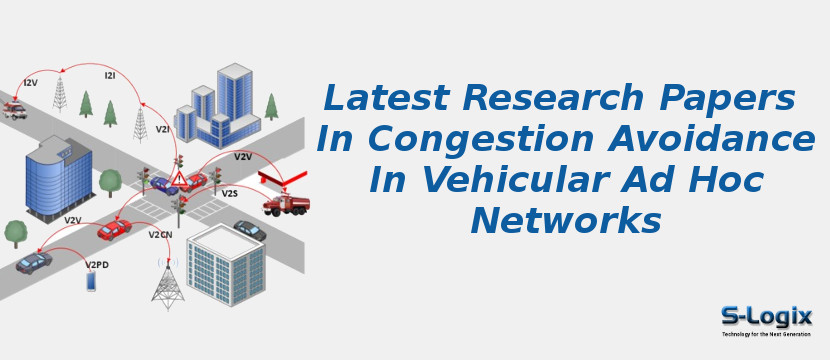
Recent research in congestion-avoidance schemes for Vehicular Ad Hoc Networks (VANETs) concentrates on proactive mechanisms that anticipate network load and vehicle density to steer clear of channel overloads and packet collisions before they occur. Researchers are integrating real-time sensing of metrics like Channel Busy Ratio (CBR), vehicle density, and queue lengths with adaptive controls such as variable transmission power, dynamic data rate adjustment, and load-aware routing to evade congested regions and maintain safe, timely dissemination of safety messages. Reinforcement-learning models are being developed to learn optimal transmission behaviors under evolving traffic and network conditions. Additionally, hybrid strategies combine centralized coordination at roadside units and distributed decisions by individual vehicles to reroute or throttle traffic flows and avoid hotspots. These advancements aim to maintain high packet delivery, low latency and robust connectivity even in dense vehicular environments by shifting from reactive congestion control to anticipatory congestion avoidance.