Research Breakthrough Possible @S-Logix

Office Address
- 2nd Floor, #7a, High School Road, Secretariat Colony Ambattur, Chennai-600053 (Landmark: SRM School) Tamil Nadu, India
- pro@slogix.in
- +91-81240 01111
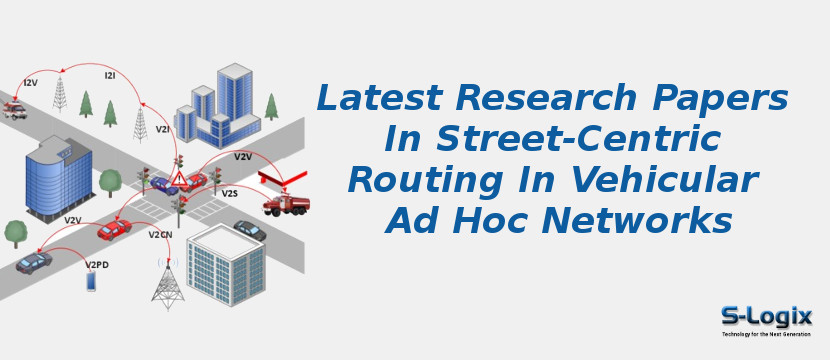
Recent research in street-centric routing for VANETs focuses on leveraging urban street topology, intersection data, and road?segment connectivity to improve routing accuracy and reliability in dense city environments. Unlike traditional vehicle-centric or node-centric approaches, street-centric schemes build routing graphs based on street segments, bus or public transit trajectories, and intersection metrics (such as street consistency or path consistency) to choose forwarding paths aligned with real vehicle flows and road structure. For example, protocols analyse bus route patterns to identify high-relay?opportunity streets and apply ant colony or other meta-heuristic optimization to select steady multihop links along those streets. Others integrate lane and street-centred QoS parameters (bandwidth, lane directionality, intersection density) into proactive routing protocols such as OLSR, so that vehicles select MultiPoint Relays (MPRs) based on both link quality and street alignment. These street-aware strategies help reduce end-to-end delay, improve packet delivery ratio, and enhance route stability in urban VANET settings where mobility is constrained by road geometry and intersections.