Research Breakthrough Possible @S-Logix

Office Address
- 2nd Floor, #7a, High School Road, Secretariat Colony Ambattur, Chennai-600053 (Landmark: SRM School) Tamil Nadu, India
- pro@slogix.in
- +91-81240 01111
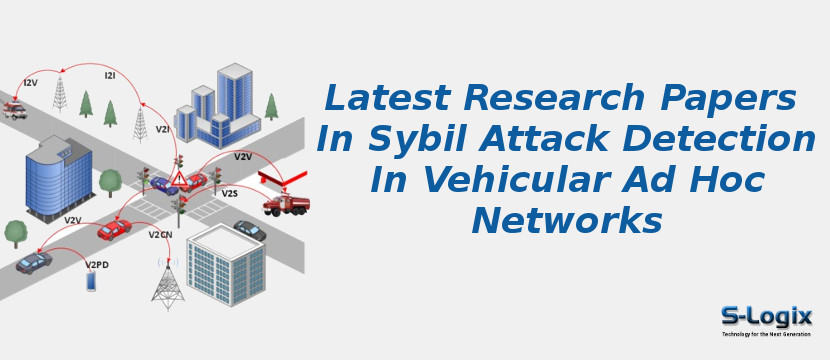
Recent research in Sybil attack detection for Vehicular Ad Hoc Networks focuses on developing intelligent and decentralized mechanisms to identify and mitigate malicious nodes that create multiple fake identities to disrupt communication and traffic safety. Advanced detection models employ machine learning and deep learning techniques to analyze mobility patterns, signal features, and communication behaviors to differentiate legitimate vehicles from Sybil attackers. Blockchain-based frameworks are being introduced to ensure identity verification and data integrity without relying on centralized authorities, enhancing trust and transparency. Some approaches also use physical layer features such as RSSI, time of arrival, and angle of arrival to detect identity spoofing with high accuracy. Additionally, fog and edge computing architectures are being integrated to provide low-latency, distributed detection and response. Overall, these emerging solutions aim to provide scalable, privacy-preserving, and real-time Sybil attack detection to enhance the reliability and security of vehicular networks.