Research Breakthrough Possible @S-Logix

Office Address
- 2nd Floor, #7a, High School Road, Secretariat Colony Ambattur, Chennai-600053 (Landmark: SRM School) Tamil Nadu, India
- pro@slogix.in
- +91-81240 01111
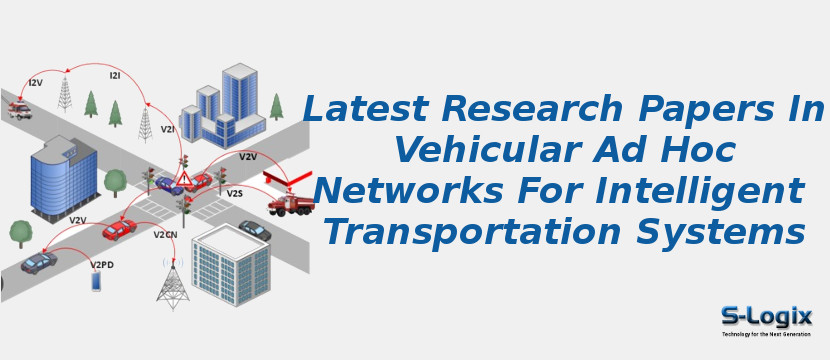
Recent research in Vehicular Ad Hoc Networks (VANETs) for Intelligent Transportation Systems (ITS) emphasizes enhancing connectivity, autonomy, and intelligence within vehicle-to-vehicle (V2V), vehicle-to-infrastructure (V2I), and vehicle-to-everything (V2X) communications to support dynamic traffic management, autonomous driving, and smart city mobility. These studies integrate artificial intelligence and machine learning for predictive routing, traffic flow optimization, and anomaly detection, while edge/fog computing and 5G/6G connectivity enable low-latency data processing and distributed decision-making. Security and privacy are becoming increasingly critical, with research focusing on trust-based models, blockchain, and federated learning to secure highly mobile and decentralized vehicular networks. Furthermore, architectures are evolving to fuse VANETs with IoT devices, sensor networks, and unmanned aerial vehicles (UAVs) to facilitate real-time data sharing, situation awareness, and coordinated responses to emergencies and congestion, positioning VANETs as foundational elements of future-generation ITS frameworks.