Research Breakthrough Possible @S-Logix

Office Address
- 2nd Floor, #7a, High School Road, Secretariat Colony Ambattur, Chennai-600053 (Landmark: SRM School) Tamil Nadu, India
- pro@slogix.in
- +91-81240 01111
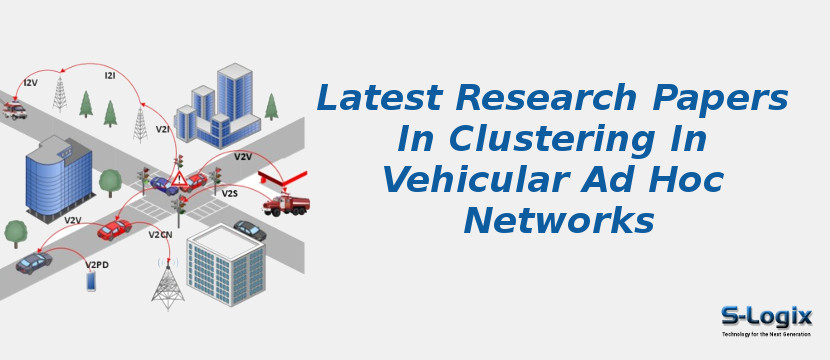
Recent research in clustering for Vehicular Ad Hoc Networks (VANETs) focuses on enhancing network scalability, stability, and communication efficiency in highly dynamic vehicular environments. Clustering techniques group vehicles into logical clusters to improve data dissemination, reduce routing overhead, and maintain reliable connectivity despite frequent topology changes. Current studies propose adaptive and intelligent clustering algorithms using machine learning, fuzzy logic, game theory, and evolutionary optimization to achieve stable cluster formation and optimal cluster head selection. Researchers also integrate hybrid clustering models that combine mobility patterns, link quality, and vehicle density to minimize cluster reformation and energy consumption. These advancements in clustering mechanisms play a crucial role in enabling efficient resource management, reducing communication latency, and ensuring seamless connectivity for safety and infotainment applications in next-generation VANETs.